

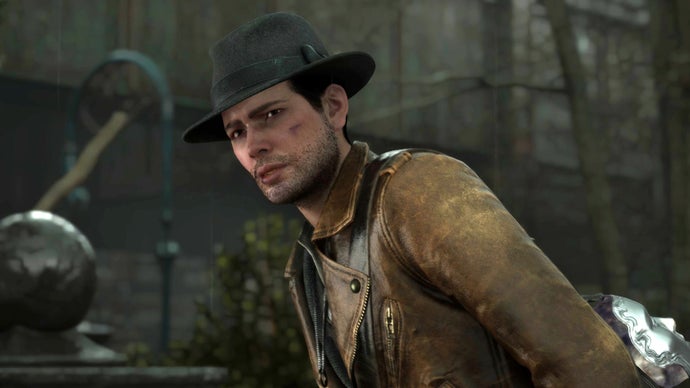
There’s a pivotal moment early in The Sinking City 2 where players enter the waterlogged halls of Miskatonic University. As you navigate around toppled shelves and wade through sodden tomes scattered across flooded corridors, a siren begins to blare ominously in the distance. It’s the final evacuation call for survivors hoping to flee the doomed city of Arkham, after which only a handful of determined souls remain behind. The atmosphere feels like a world caught in the process of transition as players join it, and that sense of change is deeply reflective of the series itself, which has undergone its own dramatic transformation between installments.
The original Sinking City, released in 2019 by Frogwares, carved out a unique niche in the crowded Lovecraftian horror genre by combining open-world exploration with detective investigation mechanics. Players assumed the role of private investigator Charles Reed, using their analytical skills to piece together clues and solve supernatural mysteries in a flooded 1920s Massachusetts city. The game earned praise for its atmospheric world-building and emphasis on player-driven investigation, even if technical limitations sometimes hindered the experience. Now, with The Sinking City 2, the development team appears to have made a conscious decision to pivot away from those cerebral elements in favor of more traditional survival horror gameplay.
A Departure From Detective Roots
This shift represents a significant departure from what made the original game distinctive. Where the first Sinking City encouraged players to think critically, connect evidence, and draw their own conclusions about unfolding mysteries, the sequel seems more interested in delivering visceral scares and tense combat encounters. The investigation mechanics that defined the predecessor—the Mind Palace deduction system, the crime scene reconstruction, the need to research archives and cross-reference clues—appear to have been scaled back considerably in favor of more action-oriented gameplay loops familiar to fans of Resident Evil and Silent Hill.
The Lovecraftian horror genre has experienced a renaissance in recent years, with games like Amnesia: The Bunker, Darkest Dungeon, and Call of Cthulhu all exploring different approaches to cosmic horror. The challenge for developers working in this space has always been translating the existential dread and incomprehensible terror of H.P. Lovecraft’s fiction into interactive experiences. Some games lean into psychological horror and atmosphere, while others embrace action and monster encounters. The Sinking City 2 appears to be firmly planting its flag in the latter camp, raising questions about whether this approach truly serves the source material’s themes of helplessness against unknowable forces.
Arkham’s Descent Into Darkness
The setting of Arkham itself remains a compelling backdrop for the horror to unfold. In Lovecraft’s original stories, Arkham served as a fictional Massachusetts town that appeared across multiple tales, home to the infamous Miskatonic University where scholars dabbled in forbidden knowledge. The Sinking City franchise has always used flooding as both a practical gameplay mechanic and a metaphor for the overwhelming nature of cosmic horror—the sense that humanity is slowly being submerged by forces beyond comprehension. The evacuation scenario presented in the sequel’s early hours effectively establishes the stakes and creates an atmosphere of desperate isolation.
The survival horror genre itself has evolved considerably since its golden age in the late 1990s and early 2000s. Modern entries like the Resident Evil remakes have demonstrated that there’s still tremendous appetite for carefully crafted horror experiences that balance resource management, puzzle-solving, and combat. However, the genre’s best entries typically succeed by making players feel vulnerable and forcing them to think strategically rather than simply react to threats. Whether The Sinking City 2 can achieve this balance while abandoning the investigative elements that distinguished its predecessor remains an open question that only the full release can answer.
The Verdict Remains Uncertain
For longtime fans of the franchise, this evolution may prove divisive. Those who appreciated the original game’s emphasis on player agency and deductive reasoning might mourn the loss of those distinctive features. Conversely, players who found the investigation mechanics tedious or poorly implemented might welcome a more streamlined, action-focused experience. The gaming landscape is filled with examples of sequels that successfully reinvented their franchises and others that lost their identity in the pursuit of broader appeal. Only time will tell which category The Sinking City 2 ultimately falls into, but the early impressions suggest a game struggling to balance its Lovecraftian heritage with contemporary survival horror expectations.
Expert Opinion: The decision to streamline investigation mechanics in favor of survival horror action represents a calculated commercial gamble that could alienate the original’s core audience while potentially attracting mainstream horror fans. Historically, franchises that abandon distinctive gameplay elements rarely recapture the magic that made them special initially—The Sinking City 2 will need exceptional execution of its survival horror fundamentals to justify this creative pivot.